Posts

Walk for Freedom in Springfield
Image
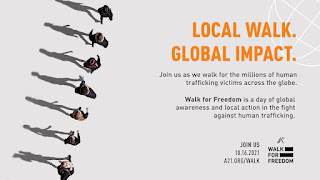
The Human Trafficking Research Lab at Millikin was asked to table at our local Walk for Freedom on October 16, 2021.  The walk is put on globally by the A21 Campaign and consisted of a 1.5 mile "silent" walk raising awareness to human trafficking in Central Illinois and beyond. The walk started at the Old State Capitol in Springfield Illinois.  Here are some photos of of the Human Trafficking Research Lab table where we provide information about the lab, highlight our research with undergraduate students, and hand out fair trade chocolate. I was also asked to be a speaker this year and I told the story of how I became interested in the issue of human trafficking and my work on the issue in Latvia, Ukraine, and Russia.

Article Published in Anti-Trafficking Review Issue 17 on Anti-Trafficking Education

Image
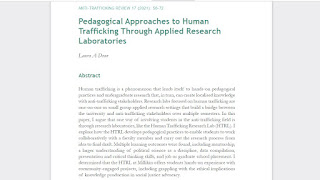
I was inspired to write an article about my experience working with students in the Human Trafficking Research Lab for the latest issue of Anti-trafficking Review on Anti-Trafficking Education and the article entitled "Pedagogical Approaches to Human Trafficking Through Applied Research Laboratories" was finally published (after four rounds of revisions) in September 2021. In the article I argue that human trafficking is a phenomenon that lends itself to hands-on pedagogical practices and undergraduate research that, in turn, can create localised knowledge with anti-trafficking stakeholders. Research labs focused on human trafficking are one-on-one or small group applied research settings that build a bridge between the university and anti-trafficking stakeholders over multiple semesters. In this paper, I argue that one way of involving students in the anti-trafficking field is through research laboratories, like the Human Trafficking Research Lab (HTRL) at Millikin Universit...

Listening Session on the Community Assessment

Image
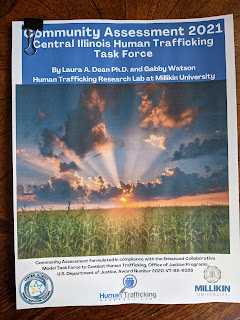
After presenting the community assessment report at our September task force meeting we wanted to give members of the Central Illinois Human Trafficking Task Force more time to read and digest the report and offer us feedback. So we organized an hour long listening session on zoom so that members could write or speak their comments questions. A true community assessment seeks to engage everyone in the community and use their feedback. As members of the community we are assessing, we have a unique level of access and familiarity with the Central Illinois Human Trafficking Task Force. This is an important caveat to our assessment approach because it involves starting an open dialogue between the Human Trafficking Research Lab and the Central Illinois Human Trafficking Task Force agencies in a concerted effort to analyze the data and allows the entities involved to buy into the data collection and the community assessment. We had about 15 task force members attend and some offered val...

Finalizing the Community Assessment Report

Image
Recently, I have been working with Dr. Dean to finalize our community assessment. The community assessment was a survey sent out to members of the Central Illinois Human Trafficking Task Force to assess the task force as part of the Department of Justice grant requirements. The survey was available to complete online or via a telephone call in which I would ask the members of the task force the questions and record their answers. It included questions in which respondents could rate the effectiveness of our task and identify its strengths and weaknesses. Our goal was to assess the effectiveness now as a pre-test in hopes that in three years, when we complete a post-test community assessment, the members of the task force will be more satisfied with their work. After the survey was completed, we began to assess the information. I worked on the qualitative information, i.e. the answers in which respondents were able to type out their response as a fill in the blank. I looked through the ...

Analyzing Arrest Records in Macon County

Image
I have been working in the Human Trafficking Research Lab over the summer. My primary duty is to analyze arrest data from 46 out of 102 counties in Illinois to detect crimes that were committed that would fall under the human trafficking category. For the past two months my main focus was analyzing Macon County arrest data where Millikin University is located. It is never an easy job, because of the description of crimes committed. In past weeks I have been analyzing arrest data form 2013 to 2018. One would think that a state like Illinois in the Midwest is free from human trafficking, in my analysis I found more than 200+ of offenses that would potentially be identified as human trafficking offenses. For example, arrests for prostitution that involve women who could be potential victims or arrests for I find this research very important, because it will allow us to keep track of those cases and follow up on whether they were properly charged with human trafficking or related adjudicat...

Freedom of Information Act (FOIA) Requests

Image
For the past few weeks, I have been working on sending Freedom of Information Act (or FOIA) requests to different counties in central Illinois. By sending these requests, we are hoping to receive the jail bookings and arrest data in these counties over the past twenty years as they relate to human trafficking cases. Though most counties accept a letter of request, some have specific forms they require to be filled out in order to receive the information we require. Thus, I have been doing research on each county to determine not only if they have specific forms required, but to determine which office would best be able to fulfill my request, as each request cannot be sent to the same offices in each county. Most State Attorney’s offices are able to help us with our requests, but not all. For some counties, the Sheriff's office holds this information. So, through trial and error, I have worked to send out these requests to whichever office is best suited to help us. Due to the natur...

Annotated Bibliography Reflections

Image
After reading serval different academic articles and case studies on human trafficking for an annotated bibliography, I noticed a patterned in the recommendations that were offered on the adjudication of human trafficking cases. One of the most common recommendation in the articles was that there needs to be more training of law enforcement officers and others who work in the criminal justice fields. The lack of training is one of the causes that hinders human trafficking cases from being investigated. When the Trafficking Victim and Prevention Act (TVPA) was passed in 2000, legislators were made aware of the human trafficking problem. They heard stories from victims and statistics on human trafficking and criminalized it. After the TVPA was created there was a still a disconnect between data from law enforcement and victims services organizations due to lack of training. If law enforcement officers received training on how to properly handle cases, then maybe we might see an increase ...